
💡 KAIST and Georgia Tech published a bare polymer membrane in Nature this week that separates crude oil at room temperature. The mechanism is counterintuitive: fouling, the buildup engineers usually try to prevent, forms nanoscale channels that do the work of separation. Lab results: 23 times higher flow rates than previous membranes. Projected energy saving for global refineries: 31%.
- Published November 5, 2026 in Nature: a bare PAN membrane separates crude oil fractions without heat, using the membrane's own fouling as the filter.
- Lab result: flow rates 23 times higher than the previous state of the art, stable over 28 consecutive days of testing on real crude oil.
- Simulated savings if used as a pretreatment step: 31.6% less energy, 37.6% lower CO2 emissions, 36% lower operating costs.
- The 31% energy saving is a projection from computer modeling, not a demonstrated result in an operating industrial refinery.
- Scaling membrane area for a large refinery and proving multi-year reliability remain the key unresolved engineering challenges.
Why Oil Refining Is One of the World's Energy Bottlenecks
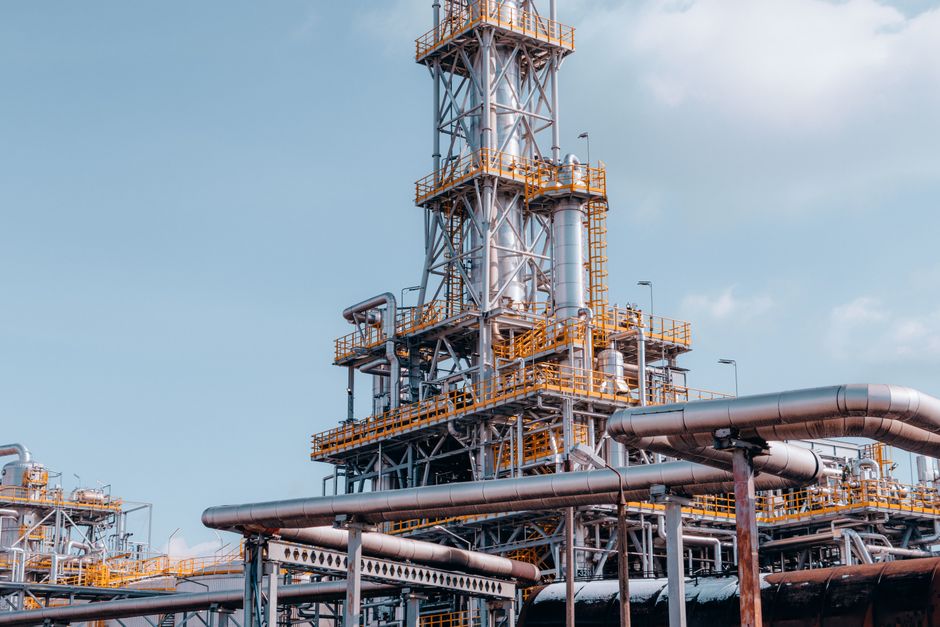
Crude oil does not come out of the ground ready to use. To separate it into naphtha, gasoline, kerosene, diesel, and heavier products, refineries heat every barrel above 350 degrees Celsius in tall distillation columns, then cool it back down. That process, unchanged at its core since the 1850s, consumes about 1,100 terawatt-hours of energy per year globally: roughly the annual output of 130 nuclear power plants, all spent on heating and cooling petroleum.
Membrane separation - filtering crude at room temperature - has been proposed for decades as a cleaner alternative. The honest objection until now: membranes were simply too slow. A membrane that worked well but processed only a trickle per square metre was an academic curiosity, not a refinery solution.
How Does a Clog Become the Filter?
Membrane fouling is usually the enemy. In water filtration, pharmaceutical production, and almost every industrial membrane application, gradual buildup of material on membrane pores reduces throughput until the membrane fails. Engineers spend enormous effort designing membranes that resist fouling.
Professor Dong-Yeun Koh's team at KAIST and Professor Ryan Lively's group at Georgia Tech discovered something different happening with crude oil and bare polyacrylonitrile (PAN) membranes. As oil flows through, heavy hydrocarbons deposit on the pore walls. Instead of blocking them randomly, the deposits narrow the pores into stable, ordered channels smaller than 2 nanometers across. Those channels are precisely sized to let lighter fractions (naphtha, gasoline, kerosene) pass through quickly while retaining heavier components. The fouling is not fighting the membrane: it is building it.
The result in lab conditions: crude oil refining membrane flow rates approximately 23 times higher than the previous leading membranes, with stable performance maintained over 28 consecutive days of continuous testing using real crude oil from HD Hyundai Oilbank.
It is worth keeping two categories of result distinct.
Demonstrated in the lab: the self-forming mechanism is real. The flow rate improvement is real. Twenty-eight days of stable operation with real crude oil is real experimental data. The researchers confirmed nanoscale channel formation using analytical techniques and found a similar effect in a second membrane material, suggesting it is not unique to PAN.
Projected by computer modeling: the 31.6% energy reduction, 37.6% CO2 cut, and 36% operating-cost saving come from process simulations of a combined membrane-and-distillation system. No industrial refinery has yet demonstrated those numbers. Simulations are valuable tools, but real facilities have complexity and variability that models simplify.
What Does a 31% Energy Cut Mean at Global Scale?
Crude oil distillation accounts for a significant slice of industrial energy use and CO2 emissions. The Nature paper's projections suggest that if the membrane approach were applied across global refining capacity, annual greenhouse gas reductions could reach tens of millions of tonnes. For Korea's refining sector alone, the researchers estimate 10 million tonnes per year.
Applied to U.S. capacity (about 18 million barrels processed daily), the Georgia Tech team's modelling suggests annual energy savings equivalent to powering 2.2 million homes and removing roughly 3 million cars from the road. The global refining sector currently uses more energy each year than most countries consume in total.
What This Means for Fuel Prices and Climate Targets
Refinery energy costs flow directly into the price of every product that comes out of a refinery: fuels, plastics, chemicals. A 36% reduction in operating costs, sustained at industrial scale, would be significant. It would not eliminate the cost of crude oil itself, which dominates refined product prices, but it would reduce the processing premium. For price-sensitive energy markets and for emerging economies where fuel costs hit hardest, that could matter over time.
For climate targets, the more significant number is the emissions side. Petroleum refining is not going away quickly: even under ambitious decarbonisation scenarios, global refining capacity is projected to remain substantial through the 2040s. Technologies that make existing infrastructure cleaner without requiring full replacement are part of the realistic toolkit for the next two decades, alongside entirely new energy sources like emerging solar materials.
PAN is an inexpensive, chemically stable material already used widely in industrial filtration. The team envisions integrating the membrane as a modular pretreatment unit that bolts onto an existing distillation column. That changes the deployment calculus considerably: a breakthrough that requires building new refineries from scratch would take decades; a module that fits an existing column is a different conversation.
What Must Still Happen Before This Reaches a Real Refinery?
Three key engineering challenges remain.
- Membrane area scaling: a large refinery processes hundreds of thousands of barrels per day. The membrane surface area required at that throughput has not been built or costed out in this research.
- Multi-year reliability: refineries expect continuous operation for years between major maintenance. The 28-day lab test is a proof of concept, not an operational lifetime.
- Industrial pilot trials: the step from simulated savings to demonstrated savings in a real facility is the critical one. No commercial partner or pilot schedule is announced in this paper.
No timeline for commercialisation is stated. The discovery of the same self-forming effect in a second membrane material suggests the science is robust enough to invest further. But the gap between a Nature paper and a refinery module is typically measured in years and significant engineering investment.
What to Watch Next
The key signal: whether a major refinery operator or membrane manufacturer announces a partnership or pilot program in the next 12 to 24 months. The researchers mention potential applications beyond crude oil, including plastic recycling and biofuel purification - two other separation-intensive processes where the same self-forming mechanism might apply. Similar materials science surprises have recently reshaped other energy problems, including earlier work on membrane systems at Georgia Tech and elsewhere.
FAQ
Is the 31% energy saving real or based on simulations?
It is a projection from computer modeling of a combined membrane-and-distillation process, not a result demonstrated in an operating refinery. The underlying lab results - 23 times higher flow rates and 28 days of stable operation on real crude oil - are from actual experiments. The energy saving figure is a credible projection based on that data, but it needs industrial verification before it can be treated as a confirmed number.
What exactly is PAN and why does it matter that it is cheap?
Polyacrylonitrile is a polymer already manufactured at large scale for filtration, textiles, and carbon-fibre precursors. Using it means the membrane material is not a bottleneck: it is available, well-understood, and relatively inexpensive. Many materials science breakthroughs fail at commercialisation because the required material is exotic or costly. PAN avoids that problem, which is one reason this result attracted a Nature publication.
Does this make oil refining clean or carbon-neutral?
No. Even with a 31.6% reduction in refinery energy use, crude oil refining still consumes enormous energy and the refined products are burned as fuels. This technology would make an existing process significantly less energy-intensive and carbon-emitting, but it does not change what crude oil is or what it is used for. It is an efficiency improvement, not a decarbonisation solution.
Could this lower fuel prices at the pump?
Possibly, over the long term. Refinery operating costs are a real component of fuel prices, and a 36% drop in those costs is significant. But crude oil purchase costs, taxes, distribution, and market competition dominate retail fuel prices. Any consumer savings would likely be modest and slow to appear, arriving only after the technology is deployed at scale across global refining capacity.
How long before this is used in a real refinery?
No timeline is published in the research. Industrial deployment typically requires a pilot phase at a real facility, proof of multi-year reliability, and a commercial licensing or partnership agreement. That path, from a lab result published in Nature to a module in production, normally takes five to fifteen years from the original result. The speed depends heavily on how quickly industrial partners engage with the research teams.
Source(s): ScienceDaily (2026); Georgia Tech Research News (2026); original paper: Nature, Vol. 654 (2026)
About the author
Dao Huy (Lucas) is a professional translator working across English, Vietnamese, Chinese, and French with over seven years of experience in technical, legal, and scientific fields. He follows frontier developments in science and technology because accurate translation of research, industrial documentation, and technical reports requires genuinely understanding the subject, not just the vocabulary.
If your work involves technical or scientific documentation that needs accurate translation into Vietnamese, Chinese, or French - including materials from energy, engineering, or industrial research sectors - Lucas offers professional technical translation services. You are welcome to request a quote at daohuy.com.

Écrit par Đào Huy (Lucas), traducteur vietnamien et spécialiste de la localisation (anglais, chinois et français vers le vietnamien). See translation services →