
3I/ATLAS Carries Alien Chemistry. Here Is What That Means.
💡 On 9 September 2026, astronomers published ALMA measurements of interstellar comet 3I/ATLAS showing methanol levels 70 to 120 times higher than any known solar system comet. The comet arrived from another star system, and its chemistry is a direct fingerprint of how icy bodies formed under conditions completely unlike our own.
- 3I/ATLAS is only the third interstellar object ever confirmed entering our solar system - after ‘Oumuamua (2017) and Borisov (2019).
- ALMA measured a methanol-to-HCN ratio of 70 to 120 in 3I/ATLAS; the richest solar system comets peak at around 3. That gap points to radically different formation chemistry in its home star system.
- Methanol outgassed from both the nucleus and from millions of tiny icy grains in the coma - a dual-source behavior not seen in any previous interstellar object.
- This is the closest thing we have to a direct chemical sample from another stellar neighborhood, without sending a spacecraft.
- Caveat: this is one object at one trajectory window. Researchers do not know which star it came from, and more data from 2025 observations is still being analyzed.
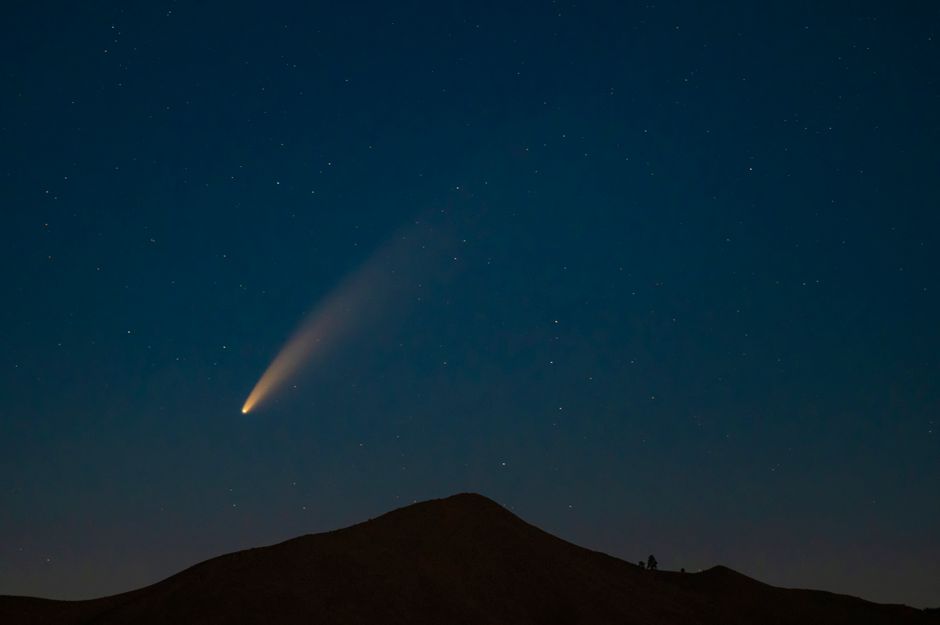
The Third Visitor: What Makes 3I/ATLAS Unusual
Before 2017, astronomers had never confirmed an object traveling from outside our solar system. Then came ‘Oumuamua, which had no visible gas tail and moved in ways that still puzzle physicists. Then Borisov (2019), which outgassed normally and looked chemically like a regular solar system comet. Interstellar comet 3I/ATLAS, discovered in July 2025 by the ATLAS sky survey, sits between them. It looks structurally like a comet - visible coma, visible tail - but chemically it carries something our solar system never made.
Scientists tracked 3I/ATLAS as it swung through the inner solar system in late 2025, near its closest approach to the Sun. That is when it was most chemically active - volatiles heating and releasing into space where ground-based instruments could read them.
What Did ALMA Actually Detect in 3I/ATLAS?
A team led by Nathan Roth at American University pointed the Atacama Large Millimeter/submillimeter Array (ALMA) in Chile at 3I/ATLAS and tracked two molecules: methanol (CH3OH) and hydrogen cyanide (HCN). Astronomers use the methanol-to-HCN ratio as a fingerprint of formation conditions. Typical solar system comets produce about 1 unit of methanol per unit of HCN. The most methanol-rich solar system comets ever found reach about 3.
3I/ATLAS measured 70 on the first observation date. Then 120 on the second.
Even more unusual: in solar system comets, methanol gas comes mainly from the nucleus. In 3I/ATLAS, it pours from both the nucleus and from millions of tiny free-floating icy grains in the surrounding coma. That dual-source behavior had never been seen in an interstellar object before. The paper, published in The Astrophysical Journal Letters on September 9, 2026, calls this “remarkably high” and notes it places 3I/ATLAS well outside the distribution of any known solar system body.
What Does This Tell Us About Other Star Systems?
Chemistry in a young solar system is shaped by the temperature and composition of the protoplanetary disk where small bodies form. A colder disk, more molecular cloud exposure, or higher carbon abundance can all push formation chemistry in unexpected directions. The fact that 3I/ATLAS carries so much methanol - and releases it so differently - strongly suggests its parent star’s formation environment looked nothing like our Sun’s.
Borisov, the previous well-studied interstellar visitor, carried chemistry broadly consistent with solar system comets. 3I/ATLAS does not. That contrast between two objects already hints at genuine chemical diversity across stellar neighborhoods. Two data points do not make a pattern, but they do make a question worth taking seriously: is our solar system’s chemistry typical, or are we an outlier?
What Should You Take Away From This?
Most of what we know about other planetary systems comes from indirect signals: a star that wobbles, a star that dims when a planet crosses in front. We can infer size and orbit. We cannot taste the chemistry.
An interstellar visitor changes that, briefly. When 3I/ATLAS outgassed near the Sun, every methanol molecule it released was a direct data point from another stellar neighborhood - one we could measure with instruments on the ground in Chile. No mission required, no decades of travel time.
For anyone thinking about whether life could exist elsewhere, this matters. The organic chemistry available during a solar system’s formation shapes what building blocks become abundant. A system like 3I/ATLAS’s home star may have built its planets and comets from a fundamentally different pantry. That is not evidence for or against life - but it confirms that the universe’s chemistry is genuinely diverse. Future instruments like the Nancy Grace Roman Space Telescope will help catch these visitors earlier and build a larger sample.
What the Data Cannot Tell Us Yet
This result is real and peer-reviewed. It is also one comet at one trajectory window. A few honest limits:
- One object is not a population. You cannot conclude that most interstellar comets look like 3I/ATLAS from a sample of one. Borisov looked nothing like it.
- No parent star identified. Tracing 3I/ATLAS back to its home system through the galaxy leaves too many possibilities. We do not know where it came from.
- The ratio was not stable. Measurements of 70 and then 120 on two dates suggest the methanol output was evolving as icy grains sublimated. The ratio is not a fixed property.
- More data is coming. Ultraviolet, infrared, and optical observations from late 2025 are still being analyzed by multiple teams. The full chemical picture will be clearer in 2027.
The honest summary: one alien comet just showed us that another star system’s icy chemistry is nothing like ours. That is real, surprising, and scientifically meaningful - but it is a beginning, not a conclusion.
FAQ
What is 3I/ATLAS and where did it come from?
3I/ATLAS is the third confirmed interstellar object ever detected entering our solar system, after ‘Oumuamua (2017) and Borisov (2019). It was discovered in July 2025 by the ATLAS sky survey. No specific home star has been identified - tracing its trajectory backward through the galaxy leaves too many possibilities with current data.
Why does a high methanol-to-HCN ratio matter scientifically?
Methanol and hydrogen cyanide form under different temperature and chemical conditions in a protoplanetary disk. A ratio of 70 to 120 in 3I/ATLAS versus about 3 in the richest solar system comets suggests its parent star’s disk was colder, richer in carbon ices, or exposed to different molecular cloud material - a fundamentally different formation environment from our own.
Does this have anything to do with whether life exists elsewhere?
Not directly - different chemistry does not mean more or less habitable, it means different. Methanol is an organic molecule, and organic chemistry is a precondition for life as we know it. But high methanol levels in a comet say nothing definitive about whether planets in that system developed life.
How is 3I/ATLAS different from ‘Oumuamua and Borisov?
‘Oumuamua had no visible coma and accelerated in ways still unexplained - it remains scientifically controversial. Borisov had chemistry consistent with solar system comets. 3I/ATLAS looks like a comet structurally but carries alien chemistry. Three interstellar visitors, three very different stories.
Will we get more data about 3I/ATLAS?
Yes - observations from late 2025 across ultraviolet, infrared, and optical wavelengths are still being analyzed by multiple teams. The comet has now passed its closest solar approach and is leaving the inner solar system, but the data collected during peak activity should fuel papers through 2027.
Source(s): ScienceDaily / The Astrophysical Journal Letters (2026); EarthSky (2026)
About the author
Dao Huy (Lucas) is a professional translator working in English, Vietnamese, Chinese, and French, with over seven years of experience in technical, legal, and scientific fields. He follows frontier science out of genuine curiosity - particularly moments where chemistry, communication, and the question of what is “universal” intersect. 3I/ATLAS is a reminder that the baseline we take for granted is really just our particular corner of the galaxy.
If you need accurate translation of technical or scientific documents - English into Vietnamese, or across any of the four languages he works in - Dao Huy offers professional translation services. Visit daohuy.com for a quote.
Written by Dao Huy (Lucas), Vietnamese translator & localization specialist (EN · ZH · FR → Vietnamese). See translation services →