
First Direct Measurement of an Exoplanet’s Magnetic Field
💡 Using the MeerKAT radio telescope array in South Africa, astronomers detected radio bursts coming directly from Beta Pictoris b, a gas giant 63 light-years away. For the first time, they measured an exoplanet magnetic field directly, finding it is roughly 2,500 times stronger than Earth’s.
- MeerKAT detected radio bursts from Beta Pictoris b across four observation sessions in 2025-2026, the first confirmed radio signal tied to a single exoplanet rather than its whole star system.
- The signal let researchers calculate a magnetic field of at least 1,250 gauss - roughly 2,500 times Earth’s and more than 100 times Jupiter’s surface field.
- Planetary magnetic fields shield atmospheres from stellar wind erosion. Mars lost most of its atmosphere after its field faded. A measurable field is on the short checklist of conditions thought to support planetary habitability.
- The paper is a preprint, not yet peer-reviewed. Confirming an aurora fully requires observing radio pulses that sync with the planet’s rotation - that step has not yet been taken.
- Beta Pictoris b is a hot gas giant, not a candidate for life. The value is the technique: we can now directly measure magnetic fields on planets orbiting other stars.
What did astronomers actually detect?
On four occasions in 2025 and 2026, a team led by Kevin N. Ortiz Ceballos, Edo Berger, and Yvette Cendes pointed the MeerKAT radio array in South Africa at Beta Pictoris, a young, bright star about 63 light-years away. They were looking for radio bursts from the giant planet known to orbit it, Beta Pictoris b.
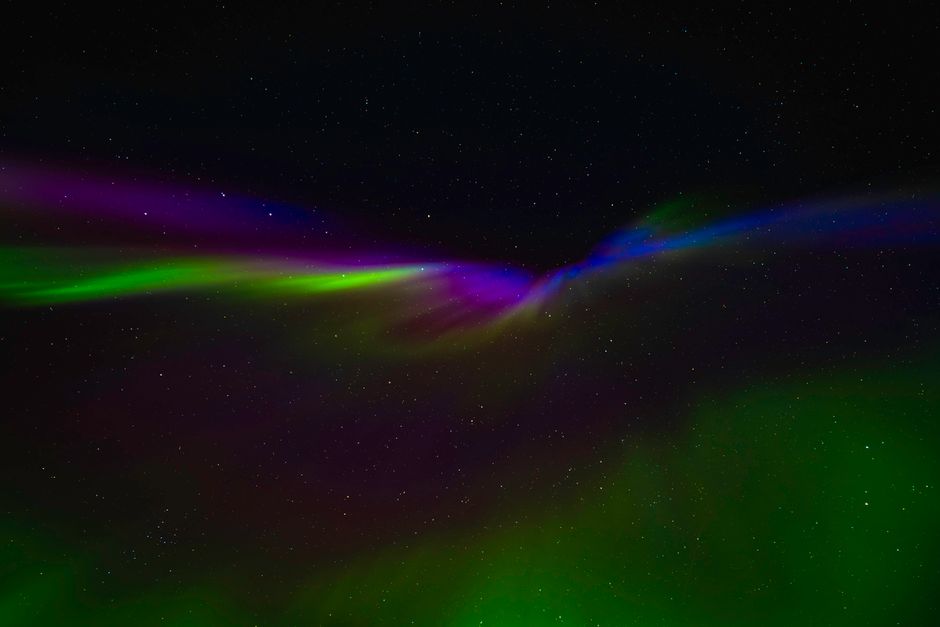
They found them. The signals were rapid, recurring, and highly circularly polarized, recorded across frequencies from 0.85 to 3.5 GHz. Crucially, the emission came from the planet itself rather than the surrounding star system. The mechanism is the same that drives auroras on Jupiter: an electron cyclotron maser instability, where charged particles spiral along magnetic field lines and release radio waves. The team submitted their findings to arXiv on September 15, 2026.
How strong is 1,250 gauss?
To put the measured exoplanet magnetic field in context: Earth’s surface field averages about 0.5 gauss. Jupiter, the largest planet in our solar system, has a surface field of roughly 4 to 10 gauss. Beta Pictoris b came in at at least 1,250 gauss - more than a hundred times Jupiter and roughly 2,500 times Earth.
That number is not surprising for what this planet is. Beta Pictoris b is young, about 20 million years old, and still hot from its formation. It is roughly 11 times Jupiter’s mass. Young, massive gas giants are expected to have strong fields as their interiors cool and contract. What is new is that we measured one, from here, directly.
Why does a planetary magnetic field matter?
Mars is the standard cautionary example. Early Mars had a magnetic field. That field faded roughly four billion years ago, and solar wind gradually stripped its atmosphere. Today Mars has about 1% of Earth’s atmospheric pressure at the surface and no liquid water.
Earth’s field deflects the solar wind. It is one of the key reasons our atmosphere and oceans have survived for billions of years. For a rocky planet to hold onto an atmosphere long enough for life to take hold, a magnetic field is widely considered important, which is why it sits on the short checklist when scientists assess a candidate exoplanet.
Until now, that measurement had never been made directly for any planet outside our solar system. Astronomers could infer fields from indirect signs, but never obtain a direct number. Beta Pictoris b just provided the first one.
What does this mean for the search for habitable worlds?
Not much directly: Beta Pictoris b is a hot gas giant with no solid surface and no plausible habitat. The star it orbits is young and bright, bathing the system in intense radiation. Nobody is looking for life there.
The significance is entirely about the technique. The same method - using auroral radio emission to detect and measure magnetic fields - could apply to other planets. The Square Kilometre Array (SKA), under construction in South Africa and Australia, will have far greater collecting area. With enough sensitivity, this approach could be applied to smaller, rockier planets around nearby stars. What we have now is the first proof that direct magnetic field measurement of an exoplanet works at all.
Alongside the Roman Space Telescope’s wide-field infrared view, radio detection of planetary magnetic fields opens a different kind of window: not what distant worlds look like, but what is happening inside them.
Where does this discovery fall short?
Several things remain unresolved. The paper is an arXiv preprint that has not yet been peer-reviewed. That is standard for cutting-edge work but the result is not yet formally confirmed by the scientific community.
Astronomer Joe Callingham described the aurora evidence as compelling but noted the interpretation is still "TBD." Confirming an auroral origin requires observing radio pulses that vary in sync with the planet’s rotation. That rotational modulation has not been documented yet, so the aurora label, while strongly supported, remains partly provisional.
Detecting a strong field in a massive, hot gas giant also says nothing directly about habitability conditions on rocky planets. Those worlds would produce far weaker signals, below what current telescopes can reliably detect.
What should you watch for next?
Peer review is the immediate gate. If the findings hold up, this becomes a formally verified first. Researchers will also try to record rotational modulation in the radio signal to pin down the aurora interpretation.
Longer term, the SKA will push sensitivity far beyond MeerKAT. If a rocky planet near a sunlike star turns out to have detectable radio emission, this technique could - for the first time - tell us whether that world has a field strong enough to protect its atmosphere.
For now, we have one measured field from one world 63 light-years out. That is still a first.
FAQ
What is Beta Pictoris b?
Beta Pictoris b is a gas giant roughly 11 times Jupiter’s mass, orbiting the star Beta Pictoris about 63 light-years from Earth. The system is estimated at around 20 million years old, far younger than our solar system at 4.6 billion years. The planet was first confirmed through direct imaging in 2008, making it one of the earliest exoplanets detected that way.
What is MeerKAT and where is it?
MeerKAT is a radio telescope array of 64 dish antennas in the Northern Cape of South Africa, operated by the South African Radio Astronomy Observatory. It is one of the world’s most sensitive radio telescopes and a precursor to the Square Kilometre Array. It detects radio waves rather than visible light, allowing it to pick up phenomena like auroral emission from planets.
How does measuring a magnetic field help find habitable planets?
Magnetic fields help shield planetary atmospheres from stellar wind erosion. Mars lost most of its atmosphere after its field faded billions of years ago. A sufficiently strong field is thought to help rocky planets retain liquid water and a stable atmosphere over long timescales. Being able to measure this directly adds a key data point to the habitability checklist, though the technique has so far only been demonstrated on a massive gas giant.
Is this confirmed as an aurora?
The emission is consistent with an aurora driven by an electron cyclotron maser instability, the same mechanism behind Jupiter’s auroral radio bursts. Full confirmation requires observing radio pulses that vary in sync with the planet’s rotation, which has not yet been documented. The aurora interpretation is the most likely explanation but remains partly provisional pending further observations and peer review.
What comes next for this research?
Peer review of the preprint is the immediate step. Researchers will also look for rotational modulation to confirm the aurora interpretation. Longer term, the Square Kilometre Array will improve sensitivity enough to potentially detect radio signals from smaller, potentially rocky exoplanets, opening the possibility of measuring magnetic fields on worlds that could conceivably be habitable.
Source(s): Ortiz Ceballos et al., arXiv:2609.16720 (Sept 2026); Science News (Sept 2026); BBC Sky at Night Magazine (Sept 2026)
About the author
Dao Huy (Lucas) is a professional translator working across English, Vietnamese, Chinese, and French with over seven years of experience. He follows the frontier of science and technology out of genuine curiosity - the question of how we read signals from distant worlds, and what they mean, is not so different from the translator’s work of decoding messages across languages and cultures.
If you need English-Vietnamese technical translation, scientific document localization, or software and technology translation, Lucas is available at daohuy.com. Get in touch for a quote.
Written by Dao Huy (Lucas), Vietnamese translator & localization specialist (EN · ZH · FR → Vietnamese). See translation services →