
MIT Built Living Transistors From Bacteria. Here Is What That Means.
💡 MIT engineers connected engineered bacteria into working transistors and, for the first time, wired them into logic circuits that can add numbers. Published in Nature Chemical Biology in August 2026, the work shows that computation is not limited to silicon, opening a path toward computers embedded directly inside living organisms.
- MIT published the first working living bacterial transistor circuits in Nature Chemical Biology on August 17, 2026, led by Christopher Voigt's lab at MIT's Department of Biological Engineering.
- The largest circuit used 24 bacterial colonies of Pantoea agglomerans to perform two-input addition, with colonies printed roughly 5 mm apart on agar plates.
- Each calculation takes roughly 8 hours - vastly slower than any electronic device, but the researchers argue this pace is acceptable for biological applications operating on agricultural timescales.
- Near-term applications include bacteria on plant roots or leaves that detect drought or pest attack and trigger biological defenses like fungicide production.
- This is a lab demonstration, not a deployed technology. Getting these circuits to function reliably inside living organisms is the next major hurdle.
What MIT actually built
In August 2026, a team at MIT's Department of Biological Engineering published a paper in Nature Chemical Biology demonstrating something genuinely new: living bacterial transistors that can be wired together into circuits that perform logic operations.
The team, led by postdoc Hamid Doosthosseini and senior author Christopher Voigt, engineered strains of the bacterium Pantoea agglomerans to function as the biological equivalent of electronic transistors. They designed two distinct transistor types and three "relay" bacterial strains that carry signals between transistors.
Using these components as building blocks, they assembled circuits performing logic operations: AND gates, OR gates, addition, demultiplexing. The largest circuit demonstrated used 24 bacterial colonies to add two inputs together. It took roughly 8 hours to complete one calculation.
How do bacteria become transistors?
A transistor is fundamentally a switch: an input signal controls whether output flows through. In a silicon chip, electrons carry the signal. In these bacterial circuits, small molecules do the job.
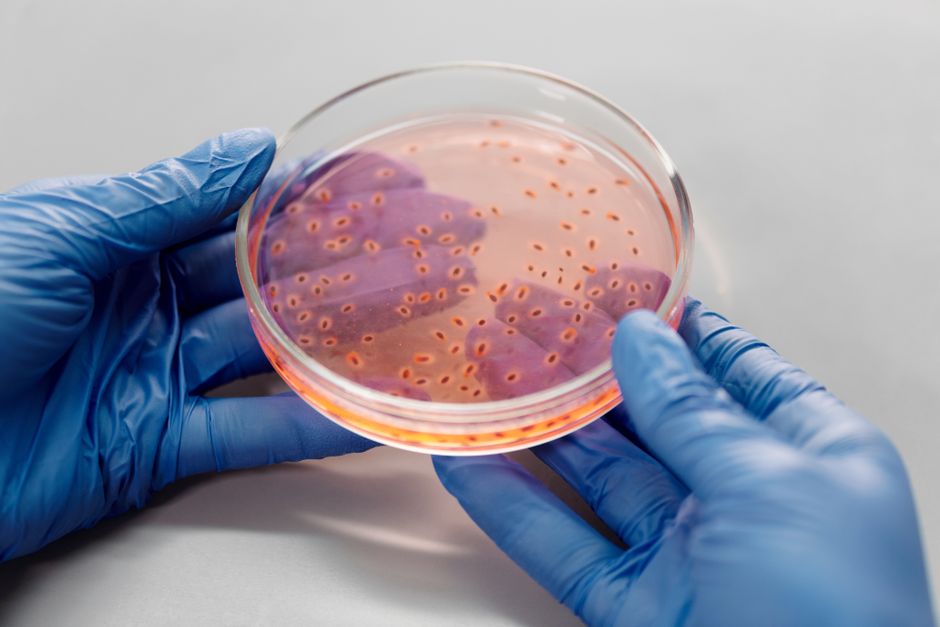
An input molecule (OC-6) switches a bacterial colony on or off. When switched on, the colony produces a different output molecule (OHC-14). Relay bacterial strains detect that output and convert it into a signal the next transistor in the chain can read. Bacterial colonies are printed onto agar plates roughly 5 mm apart, and molecular signals diffuse between them.
The elegance is in the modularity. The three relay strains mean researchers can reconfigure a circuit without redesigning every component from scratch - much like plugging different chips into a circuit board. This standardization is what makes the approach potentially scalable.
Is this going to replace your laptop?
No. These bacterial computers operate at a timescale your phone would find laughable. Eight hours for one arithmetic operation compares to billions of operations per second in a modern processor.
Christopher Voigt's claim that "computationally, there's nothing that your iPhone can do that these circuits couldn't do" is technically true but deeply misleading without context. In principle, any computation can be done with the right logic gates. The gap is speed, scale, and deployability.
These circuits are not trying to compete with silicon. They are trying to do something silicon cannot: compute inside a living organism, using the organism's own chemistry, on the organism's own timescales. That is a completely different problem - and for some applications, the 8-hour speed is entirely acceptable.
What does this mean for you?
The most near-term application the MIT team described is agriculture. Bacteria engineered to live on the roots or leaves of a crop plant could detect the chemical signal of drought stress or a fungal attack and, running a logic circuit overnight, trigger a targeted biological response: producing a fungicide, releasing a warning molecule, or changing the plant's own gene expression.
For farming, an 8-hour computation is genuinely fast. A growing season lasts months. A bacterial circuit that catches a pest outbreak before it spreads, running automatically without any electronic sensor or human intervention, is a compelling idea.
The longer horizon includes medicine. According to the MIT announcement, bacteria already live in, on, and around organisms in enormous numbers. A bacterial circuit wired into gut bacteria that detects an inflammatory marker and releases a therapeutic molecule is a plausible long-term goal - though it remains years of regulatory and biological engineering away.
For communicators and translators who work in biotechnology, regulatory affairs, or scientific publishing, this work is also a signal: biological computing is growing fast enough to generate its own documentation, patent filings, and regulatory language that needs clear, accurate translation across audiences and languages.
The real limits: what biological computing cannot do yet
The current circuits work on agar plates in controlled lab conditions. They require precise colony spacing, the right input molecules, and stable environments. Deploying them inside a living organism adds layers of biological complexity the current work does not address.
Speed remains the fundamental constraint. Any application requiring real-time response - monitoring a patient's blood pressure or reacting to a fast-moving pathogen - makes 8 hours completely unworkable. Future work may accelerate molecular signaling, but diffusion-based communication has physical limits that silicon transistors do not face.
Scale is the other challenge. A 24-colony circuit that adds two numbers is an impressive demonstration. A circuit capable of complex real-world sensing and response will need many more nodes, precisely arranged, reliably maintained inside an organism that has its own biological agenda.
The funding came partly from DARPA and IARPA, US defense and intelligence research agencies. Their involvement signals serious interest in biosensor and biodefense applications. It also signals the research community's honest assessment: this is early-stage exploration, not near-term commercialization.
What to watch next
The immediate next steps are increasing circuit complexity and reducing the time per operation. The team's modular approach - standardized transistors and relay strains - is designed to make scaling tractable. Follow-on papers from Voigt's lab and from competing groups in synthetic biology across Europe and Asia are worth watching.
The second frontier is deployment: getting these circuits to function reliably inside a plant root, a soil microbiome, or eventually a mammalian body. Each environment introduces unpredictable biological variables that controlled lab conditions do not have. That transition from petri dish to living organism will be the true test of whether biological computing is a new paradigm or an elegant demonstration.
FAQ
What is a bacterial transistor and how does it work?
A bacterial transistor is an engineered colony of bacteria that acts like an electronic switch. An input molecule turns the colony on or off; when on, it produces an output molecule that feeds the next component in the circuit. MIT used colonies of Pantoea agglomerans printed on agar plates to build logic gates and arithmetic circuits from these biological switches.
How fast are bacterial computers compared to electronic ones?
Much slower. The MIT circuits take roughly 8 hours per calculation. A modern smartphone processor performs billions of operations per second. These systems do not compete with silicon on speed. They target applications where embedding computation inside a living organism is the goal and overnight computation is fast enough - detecting crop stress during a growing season is a good example.
Will bacterial circuits ever work inside the human body?
It is a genuine long-term research goal. Bacteria already inhabit the human gut in vast numbers. A bacterial circuit that detects a disease marker and releases a therapeutic molecule is theoretically possible. But the path from a lab agar-plate demonstration to a reliable, safe in-body biological circuit involves regulatory approval, extensive safety testing, and significant bioengineering challenges still unsolved.
What crops or plants would benefit most from this technology?
Crops vulnerable to unpredictable stress - drought, fungal attack, or pest outbreak - are the primary candidates. The MIT team specifically mentioned detecting drought stress and triggering fungicide production. Row crops like corn, soybeans, and wheat are obvious targets, but any plant that can host engineered bacteria in its root zone or on its leaf surface could potentially benefit as the technology matures.
Who funded this research and what does that tell us about its direction?
DARPA and IARPA - US defense and intelligence research agencies - contributed funding. Both focus on technology that is years to decades from deployment but that could shift what is possible. Their involvement signals serious interest in biosensor and biodefense applications, and also the research community's honest assessment: this is early-stage exploration rather than near-term commercialization.
Source(s): MIT News (2026); ScienceDaily (2026); Nature Chemical Biology, doi:10.1038/s41589-026-02300-3 (2026)
About the author
Dao Huy (Lucas) is a professional translator working across English, Vietnamese, Chinese, and French, with over 7 years of experience in technical, legal, and scientific communication. He follows the frontier of science and technology out of genuine curiosity - with a particular interest in how new discoveries require new language, and how the clearest explanation is often the most valuable thing a communicator can offer. Credentials: BA, IELTS 7.0, HSK 5, Upwork Top-Rated Plus.
If your organization is publishing biotechnology research, patent documentation, or regulatory filings that need English-Vietnamese translation or technical localization, Lucas offers professional translation services tailored to scientific and IP content. Request a quote at daohuy.com.
Written by Dao Huy (Lucas), Vietnamese translator & localization specialist (EN · ZH · FR → Vietnamese). See translation services →