
Scientists Filmed Plasma Whirlpools on the Sun for the First Time
💡 Scientists have directly filmed plasma whirlpools spinning on the Sun's surface for the first time - some just 20 kilometres wide. Published in Nature on 5 August 2026, the finding reveals a hidden process that may help explain why the Sun's outer atmosphere burns a million degrees hotter than its visible surface, and how solar storms are powered.
- The NSF Daniel K. Inouye Solar Telescope identified 47 distinct plasma vortex structures on the Sun's photosphere - the highest-resolution solar surface images ever taken.
- The whirlpools, 20-200 km wide, are Kelvin-Helmholtz instabilities (KHI) - the same physics behind ocean waves and Jupiter's cloud bands.
- KHI may help explain an 80-year mystery: why the Sun's corona reaches 1-3 million °C while its surface is just ~5,500 °C.
- These vortices are linked to the solar flares and coronal mass ejections that disrupt GPS, satellites, and power grids on Earth.
- Honest limit: researchers have not yet measured how much energy KHI actually transports upward - that quantification is the essential next step.
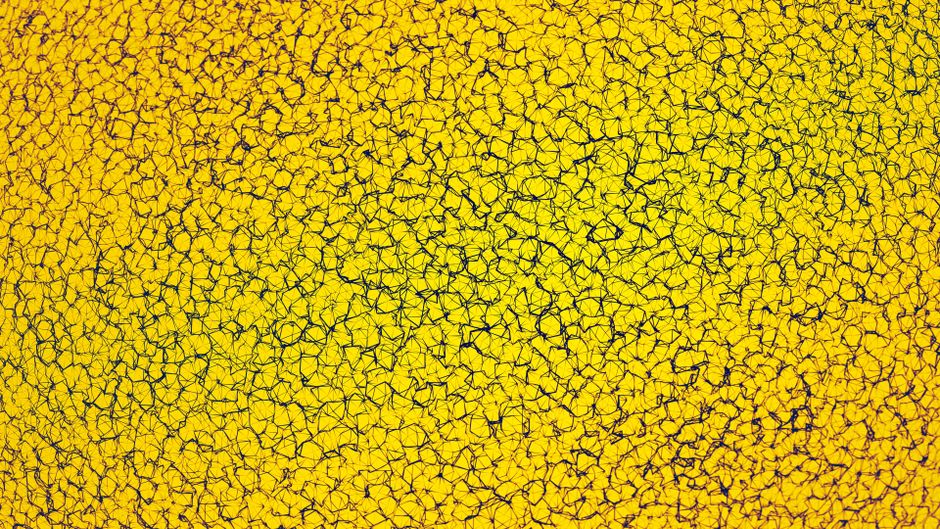
What the telescope actually captured
The NSF Daniel K. Inouye Solar Telescope (DKIST), a 4-metre instrument on Haleakala, Maui, is the world's most powerful solar telescope. An international team from the National Solar Observatory, NSF's National Center for Atmospheric Research, and the Max Planck Institute for Solar System Research published a paper in Nature on 5 August 2026 showing something predicted for decades but never directly seen: spinning vortices of plasma on the solar photosphere.
The team identified 47 distinct vortex structures in their images and confirmed the pattern with computer simulations. These whirlpools form at the boundary zones between magnetic concentrations near sunspots and surrounding plasma, ranging from about 20 to 200 kilometres across, with a median spacing of roughly 65 kilometres.
"To detect the vortices, we needed to resolve structures about 20 kilometres in size," co-author Michiel van Noort noted. "That is at the limit of what even the world's largest solar telescope can achieve."
What exactly are these plasma whirlpools?
Kelvin-Helmholtz instabilities (KHI) are a fundamental fluid-dynamics phenomenon first described in the 1870s. They form whenever two fluids flow past each other at different speeds: the faster stream grips the slower one and curls it into spirals.
This is the same physics behind rolling ocean waves on a windy day, the turbulent wakes behind aircraft wings, and the striped cloud bands of Jupiter and Saturn. It is ubiquitous in fluid mechanics, oceanography, and astrophysics - but until now had never been directly observed on the Sun's surface. Earlier this month, research showed that ordinary sunlight can generate quantum entanglement without lasers - another reminder that the Sun keeps surprising physicists with fundamental, newly discovered behaviour.
Why does the Sun's corona run a million degrees hotter than its surface?
The solar surface sits at roughly 5,500 °C. The corona - the wispy outer atmosphere visible during total solar eclipses - reaches one million to three million degrees. That temperature inversion has puzzled physicists for over 80 years, because basic thermodynamics says moving away from a heat source should mean cooling.
Two mechanisms had been proposed: acoustic waves carrying energy upward, and tiny magnetic "nanoflares" releasing stored energy. The new finding adds a third: Kelvin-Helmholtz instabilities may continuously twist and tangle magnetic field lines, building up stored magnetic energy that eventually dissipates as heat. The vortices could act as a constant stirring machine feeding energy from the photosphere into the corona.
This does not fully solve the coronal heating problem. But it is the first directly observed, physically confirmed mechanism of this type.
How does this connect to your daily life?
The corona is not just a scientific curiosity. It is where space weather originates. Solar flares and coronal mass ejections (CMEs) launch billion-tonne plasma clouds toward Earth at millions of kilometres per hour. When they strike Earth's magnetic field, the consequences cascade: power grid overloads, satellite failures, GPS errors of several metres, and radio blackouts.
The economic stakes are real. A moderate CME in 1989 blacked out the entire province of Quebec for nine hours. Analysts estimate a severe storm today could cost hundreds of billions of dollars in infrastructure damage globally. Better understanding of what triggers and powers CMEs at their solar source - now including KHI - gives forecasters a firmer physical basis for their models and more reliable warning timelines.
What are the honest limits of this finding?
The 47 vortex structures were observed in one magnetically active region near a sunspot during limited observing windows. Whether KHI is equally active in quieter solar regions, or at different phases of the 11-year solar cycle, has not yet been confirmed.
Most critically, the team has not yet measured how much energy the vortices actually transport upward. That is the key number: without it, scientists cannot say what fraction of coronal heating KHI explains. The current result is a proof of existence, not a full quantitative accounting.
What comes next?
The team plans to build automated vortex-detection software for the Inouye telescope's growing data archive - moving from 47 hand-identified examples to potentially thousands. That will allow the first statistical estimates of KHI's energy contribution to the corona. The Inouye telescope is also being expanded with instruments to observe the corona directly, so researchers can trace energy from the surface whirlpools up into the hot atmosphere above.
Astronomer Mihalis Mathioudakis of Queen's University Belfast, not involved in the study, called it "a major breakthrough in solar physics," noting its significance comes precisely from direct imaging rather than modelling.
FAQ
What are Kelvin-Helmholtz instabilities on the Sun?
Kelvin-Helmholtz instabilities (KHI) are swirling vortices that form when two plasma streams move at different speeds along a boundary between magnetic structures. The faster flow curls the slower into spirals - the same physics behind ocean waves and Jupiter's cloud bands, now observed directly on the solar surface for the first time.
Why is the Sun's corona so much hotter than its surface?
This is one of solar physics' biggest unsolved puzzles. The surface is about 5,500 °C, but the outer corona reaches 1-3 million °C. Scientists suspect energy is deposited there by acoustic waves, magnetic nanoflares, and now possibly Kelvin-Helmholtz instabilities that tangle and release magnetic energy. No single mechanism has yet been confirmed as the dominant source.
How could solar whirlpools affect GPS and power grids?
KHI may help power the solar flares and coronal mass ejections that send plasma clouds toward Earth. When these hit Earth's magnetic field, they induce currents in power lines and satellites, causing grid failures, GPS errors, and radio blackouts. Better understanding of the solar source should eventually improve forecast accuracy and warning times for space weather operators.
Which telescope discovered the solar whirlpools?
The NSF Daniel K. Inouye Solar Telescope (DKIST) on Haleakala, Maui, Hawaii - the world's most powerful solar telescope. Its 4-metre primary mirror produces the highest-resolution images of the Sun's surface ever taken, resolving structures just 20 km wide from 150 million kilometres away.
Does this discovery solve the coronal heating mystery?
Not yet. The study confirms KHI exists on the Sun's surface and provides a plausible mechanism for transporting energy upward. But researchers have not yet quantified how much energy the vortices carry, so it is not yet possible to say what fraction of coronal heating they explain. That measurement is the critical next step.
Source(s): NSF National Solar Observatory Press Release (2026); Scientific American - Solar Whirlpools (2026)
About the author
Dao Huy (Lucas) is a professional translator (English, Vietnamese, Chinese, French) with over seven years of experience in technical, legal, and scientific communication. He follows the frontier of science and technology out of genuine curiosity, translating not just words but ideas across languages and disciplines. This discovery resonated because the challenge at its core is one translators know well: finding the signal in noise, and making the meaning clear across contexts.
Lucas offers professional English-to-Vietnamese, technical, and IP translation services, including software and tech localization. If you need accurate, reader-first translations for your documents or projects, request a quote at daohuy.com.
Written by Dao Huy (Lucas), Vietnamese translator & localization specialist (EN · ZH · FR → Vietnamese). See translation services →