
💡 The Vera C. Rubin Observatory found two previously invisible Milky Way companions in just the first 7% of its planned sky survey. Both objects are almost entirely dark matter. With hundreds more likely hidden, Rubin has just launched the most consequential count of our galaxy's dark matter halos in decades.
- Rubin found Aquarius IV (an ultra-faint galaxy 355,000 light-years away) and Rubin-GC1 (a dust-hidden star cluster on the galaxy's far side), both previously unknown to science.
- These two objects were spotted in preview data covering roughly 7% of the sky the full 10-year survey will eventually map, suggesting many more discoveries are coming.
- Ultra-faint dwarf galaxies like Aquarius IV are 99 to 99.9% dark matter by mass, making them direct and powerful tests of our models of how dark matter behaves.
- The missing satellite problem: cosmological models predict 100 to 300 satellite galaxies should orbit the Milky Way; only about 65 were known before this discovery.
- Caveat: Aquarius IV's classification as a galaxy is still preliminary, and spectroscopic measurements are needed to confirm its dark matter content definitively.
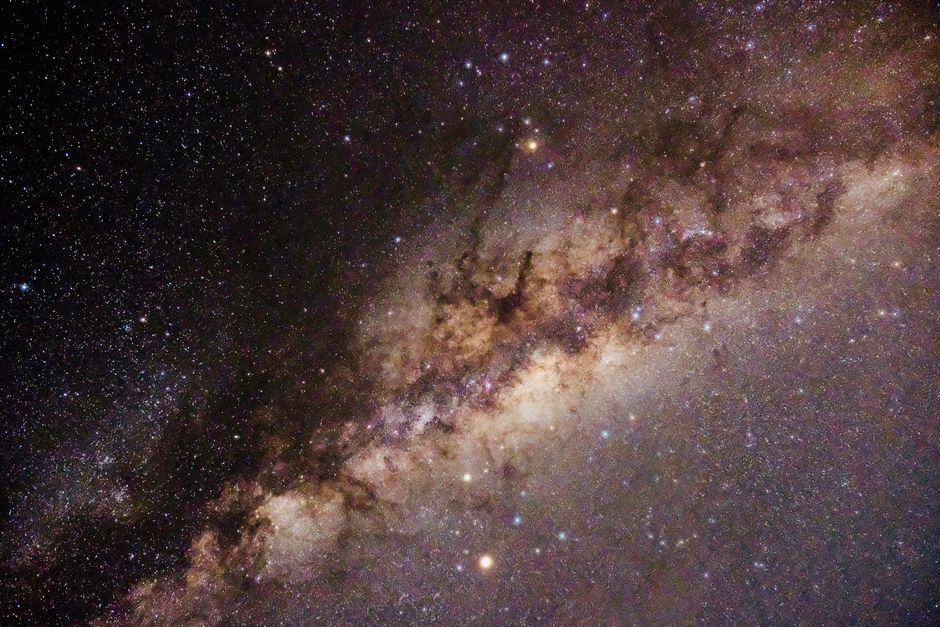
Rubin's first harvest: two new Milky Way companions emerge from the dark
In November 2026, a team led by William Cerny of Yale University published two studies using early data from the Vera C. Rubin Observatory, announcing the discovery of two objects that had never been detected before. The first, Aquarius IV, is an ultra-faint dwarf galaxy sitting roughly 355,000 light-years from Earth, in the outer halo of the Milky Way. The second, Rubin-GC1, is a star cluster buried on the galaxy's far side behind thick clouds of cosmic dust, exactly the kind of object older telescopes couldn't reach.
What makes the find unusual is how little of the sky Rubin had actually examined. The preview data used for these discoveries covered only about 7% of the sky the observatory's full Legacy Survey of Space and Time will eventually map over ten years. If the first 7% yields two new Milky Way satellite galaxies, the next 93% could be transformative for how we understand our galaxy's neighborhood.
The Rubin Observatory, based at Cerro Pachon in Chile, operates the largest digital camera ever built for astronomy: a 3.2-gigapixel sensor attached to an 8.4-meter telescope. Its full 10-year survey officially began in June 2026, and preview data alone is already rewriting the map of the Milky Way's outer halo.
What is the missing satellite problem?
For roughly three decades, cosmologists have used computer simulations based on Cold Dark Matter models to predict how many small satellite galaxies should orbit a large spiral galaxy like the Milky Way. Those models consistently predict the answer should be somewhere between 100 and 300 companions. But when astronomers count the actual known satellites, the total has long hovered around 65.
This discrepancy is called the missing satellite problem, and it has been one of the thorniest puzzles in modern cosmology. There are two possible explanations. Either the standard Cold Dark Matter model is wrong in some important way. Or the missing satellites are real and simply too faint to detect with older instruments.
Rubin was built, in part, to answer this question. Its unprecedented depth and sensitivity let it detect objects that are orders of magnitude fainter than what prior large surveys could resolve. The discovery of Aquarius IV, described by co-author Aashay Pai as "one of the faintest and most compact ultra-faint dwarf galaxies at a large distance," is precisely the kind of object the missing satellite problem predicts should exist.
Why are faint galaxies almost entirely dark matter?
Normal large galaxies like the Milky Way or Andromeda are complex objects: stars, gas, dust, planets, and dark matter all mix together. In ultra-faint dwarf galaxies, the story is very different. These objects contain so few stars that the visible matter is almost negligible. According to Joshua Simon of the Carnegie Observatories, in ultra-faint galaxies like Aquarius IV, dark matter accounts for 99 to 99.9% of the total mass.
That extreme ratio makes ultra-faint galaxies extraordinarily useful. Because there is almost no visible matter to complicate the measurement, astronomers can measure the dark matter distribution almost directly by tracking how the small number of stars move under gravity. That motion reveals the mass enclosed, and since the stars themselves contribute almost nothing, what you are measuring is essentially pure dark matter structure.
This is why each new ultra-faint satellite found by Rubin is scientifically valuable: it is a nearly direct data point about the nature, distribution, and behavior of dark matter, something that otherwise cannot be seen or detected except through its gravitational pull.
What this means for you: dark matter is becoming countable
Dark matter makes up roughly 27% of the total energy content of the universe, yet we have never directly detected a single dark matter particle in a laboratory. For decades, physicists have debated whether dark matter is a weakly interacting massive particle, some other exotic candidate, or whether our theory of gravity needs revision at certain scales.
The number and distribution of Milky Way satellite galaxies is one of the most direct observational tests of these competing ideas. If Rubin's full 10-year survey finds the 100 to 300 companions that Cold Dark Matter models predict, that is powerful evidence those models are on the right track. If it finds far fewer even after a thorough survey, the models need revision, and the implications ripple through all of fundamental physics.
What changed this week is not that we know the answer yet. What changed is that the most capable instrument ever built for this question has just produced its first real results, and they look promising. For anyone who has followed the dark matter debate, Rubin finding two new companions in just 7% of its survey is comparable to a new microscope finally resolving a cell structure that biologists had theorized for 30 years but never confirmed. The question is no longer "can we find them?" It is: "how many are there?"
Does finding more satellites solve the dark matter mystery?
Not directly, but it narrows the problem significantly. Each confirmed satellite galaxy is a new data point: how massive is it, how much dark matter does it contain, what shape is its dark matter halo, is the density profile what models predict? Accumulating dozens or hundreds of these measurements over the next decade gives theorists real constraints to work with instead of theory alone.
If Rubin eventually finds that the total number of satellites matches Cold Dark Matter predictions, that removes one of the main objections to those models. If Rubin finds far fewer than predicted even after a thorough search, that is a signal that something is genuinely wrong with the standard picture, possibly pointing toward alternative dark matter candidates or modifications to how gravity behaves at small scales.
The honest limits: what we do not know yet
Several important caveats apply to these early results. First, Aquarius IV's classification as a galaxy remains preliminary. It could turn out to be an unusually large and distant globular cluster rather than a true dark-matter-dominated dwarf galaxy. Only spectroscopic measurements of how its stars move can confirm dark matter dominance, and that work is still in progress.
Second, the Aquarius IV paper was published in Research Notes of the AAS, a rapid-communication journal that does not require traditional peer review. That does not make the finding wrong, but external scrutiny is still ongoing.
Third, extrapolating from 7% of the sky to the full galaxy halo involves assumptions. The sky coverage so far is not random, and the patches already mapped may not be fully representative of the whole outer halo.
Fourth, finding satellite galaxies does not tell us what dark matter is. It tests models of how dark matter clusters and behaves gravitationally, but the nature of the particle or field remains completely unknown. The discovery is a step toward constraining the problem, not a solution to it.
FAQ
What is the Vera C. Rubin Observatory?
The Rubin Observatory is an 8.4-meter telescope in Chile equipped with the largest astronomical camera ever built: 3.2 gigapixels. Its 10-year Legacy Survey of Space and Time (LSST), which began in mid-2026, will scan the entire southern sky repeatedly, building the deepest and most detailed map of the universe ever produced. The survey is expected to run until approximately 2036.
What is the missing satellite problem in astronomy?
Cosmological simulations predict the Milky Way should have between 100 and 300 small satellite galaxies orbiting it. But astronomers have only confirmed around 65. This gap has been a puzzle since the 1990s: either the standard Cold Dark Matter model is wrong in some way, or the missing satellites are too faint for older instruments to detect. Rubin was built partly to resolve this.
How can a galaxy be almost entirely dark matter?
Ultra-faint dwarf galaxies form from dark matter halos that never gathered enough gas and dust to build many stars. The result is an object dominated almost entirely by dark matter, 99 to 99.9% by mass, with only a small scattering of old, dim stars visible. That extreme ratio makes them ideal for measuring dark matter structure directly, without interference from normal matter.
How was Aquarius IV found if it is too faint to see with older telescopes?
Rubin's 3.2-gigapixel camera and 8.4-meter mirror can detect objects far dimmer than any previous wide-field survey telescope. The team identified an excess density of faint stars in a specific pattern, too coherent to be random background noise. It is essentially finding a hidden crowd by detecting a subtle but statistically significant thickening in the density of stars at that location.
When will we know how many Milky Way satellites there really are?
The full picture should come into focus over Rubin's 10-year survey from 2026 to 2036. Each passing year adds more sky coverage and depth. A statistically complete census of the full sky will likely emerge in the early 2030s, and the final count will be one of the most important tests of dark matter models in a generation.
Source(s): ScienceDaily / Yale University (2026); University of Washington News (2026); Nature World News (2026)
About the author
Dao Huy (Lucas) is a professional translator working in English, Vietnamese, Chinese, and French with 7 years of experience across scientific, technical, and literary texts. He follows developments at the frontier of science and technology out of genuine curiosity, and finds that fields like cosmology raise the same questions he encounters in translation: how do you describe something in a language that may not yet have precise words for it?
If your work involves scientific, technical, or IP documents that need accurate English-Vietnamese translation or software localization, Lucas offers professional services at daohuy.com. Feel free to reach out for a quote.

Written by Dao Huy (Lucas), Vietnamese translator and localization specialist (English, Chinese and French into Vietnamese). See translation services →